
Repeat (Mostly)--Always Timely, Unfortunately--How Can We Have Morality in a Secular Society?
23 January 2026--mostly a repeat from 2023--Friday Freethought Perennial #28

About the Friday Freethought Perennials in general: This subset of my blog is to answer questions, nearly always already answered by me and by many others but posed again and again—over many years and in many places—on freethought, atheism, secular humanism, secularism/church-state/”This is a Christian Nation,” and similar topics. These answers are mostly not intended to be original analyses, breaths of fresh air, so much as just putting a whole series of things on the record (I’d say “forever,” except I know better). One source for many of these answers is the 2012 Prometheus Books book by me and my son (Michael E. Buckner), In Freedom We Trust: An Atheist Guide to Religious Liberty. It’s available in many libraries and pretty readily in the used book after-market. I’ll cite writings of others that answer these things in more depth if I’m aware of them when I post these.
This essay is based closely on a chapter (Chapter 15) in our book, In Freedom We Trust. This Substack essay includes little documentation, but the book chapter is carefully footnoted as to sources, in case that is wanted.
This is needed as a repeat partly because of a recent allegedly impressive podcast on an aspect of the subject from Catholic.com featuring Trent Horn, who recently released an episode titled "The Moral Madness of Atheism":
https://www.catholic.com/audio/cot/the-moral-madness-of-atheism
He avoids the most simplistic versions (the ones for example claiming all good behavior is exclusively by “God-believers”) in favor of claiming that the idea of goodness itself has to come from God. His argument is a bit more sophisticated than that—and you can watch the podcast or read the transcript (replete with a few typos) at the above link.
I’m reasonably assured, by atheist philosophers I respect, that these claims fail. But. here’s my take from years ago on the broader practical questions—
The Big Lie: Morality and Conscience in a Secular Society
Quite likely the most persistent idea used to defame atheists—and sometimes to defame anyone who is not a follower of an approved sect of an approved religion—is the claim that religious belief and morality are causally interdependent. This “big lie” is often used, explicitly or implicitly, to attack the whole idea of a secular society. And if the lie is believed, support for secularism can crumble. After all, no one in his right mind wants a society where moral standards are not generally understood and taken quite seriously by all or nearly all citizens. Social order, individual freedom, economic functioning, and more depend on agreed on ideas of what constitutes proper behavior towards one’s fellow citizens. Deeply religious people often sincerely believe that the moral standards they cherish come to them from God, but in a free society where individual liberty is protected, everyone, from the most deeply religious to the most militantly atheistic, must maintain the theoretical possibility that he does not have everything exactly right about ultimate values. “Religious,” as I use it here, just means living in some way, loosely or thoughtfully and carefully, on ideas connected to belief in supernatural being(s). The alternative is some kind of conflict, even war, or sustained repression of one set of ideas or another.
Theists, especially fundamentalists, repeatedly and successfully (in political terms, not philosophical or realistic terms) claim morality requires theism. This approach has been used so often that it is unnecessary to offer many examples, but Billy Graham offered a typical version in his weekly newspaper column years ago. Replying to an atheist who declared that knowing the difference between right and wrong and how to get along with people, not belief in God, are what matters, Graham wrote:
First, if God doesn’t exist, then how do we know what is right and what is wrong? Somethings may seem more “right” than others—but how do we know they really are? The answer is—we don’t. The only reliable way to know what is right and wrong, and how we should treat others, is if God tells us—and He has done this in His Word, the Bible.
My second question is this: What about your children? Will they grow up with the same values you have—or will they do like so many atheists do, and simply make up their own moral standards?
Though they are demonstrably incorrect, the political success of claims like Graham’s is a threat to secularism and hence to liberty, not merely a threat to nontheists. It is for that reason that what I call “the big lie”—the often unquestioned assertion that religiosity and morality go hand in hand—is refuted here. Many works by moral philosophers and others have shown the false correlation (see such works as Living Without Religion (1994) by Paul Kurtz; The Moral Sense (1993) by James Q. Wilson; Six Great Ideas (1981) by Mortimer Adler; The Moral Landscape (2010) by Sam Harris; Biblical v. Secular Ethics (1988), edited by R. Joseph Hoffman and Gerald LaRue; and Ethics (1994), edited by Peter Singer), but the main points of those arguments will be reiterated here. A succinct and effective summary of the biological, evolutionary, basis for morality—and of the reasons we should understand that as positive, not dangerous—appeared in a 2011 essay by Jerry A. Coyne titled, “As Atheists Know, You can be Good without God.”
The most common variation of this approach—or at least a closely related argument—by anti-secularists is to pretend that the only choice for the origin of human rights, like morality, is God and not from government. They often cite the American Declaration of Independence as showing that the founders of the United States unequivocally chose God, not government as the source. The language in the Declaration does indeed attribute the source to “Nature’s God” (not, please note, to the Christian God), but in the US Constitution—our governing charter—there is no allusion even to this more deistic version of a god. (For much more on the Declaration, see an earlier Letter…, “The Unchristian Roots of the Fourth of July,” by Michael E. Buckner) If any source for rights can be inferred from the Constitution, that source would be from “We the People,” the source implied in the Preamble. But it is all a false dilemma in any case. Rights can indeed be considered “natural”—essentially derived from a major societal consensus—without being treated as coming from a government or from a god. Moral standards, in a somewhat similar way, can be derived from individual rights or societal needs or, in practice, from long cultural evolution and deep-seated consensus. Such standards, embodied most obviously but not comprehensively in criminal codes, do have to be very broadly socially accepted to be effective, but religious ideals are as likely to interfere with the needed consensus in a pluralistic society as to support them.
Most Islamic understanding of morality is quite different from the approach most modern Christians take, but Islamic opposition to secularism is frequently rooted in fears related to morality. As Melanie Phillips summed it up in The World Turned Upside Down (2010),
America is the principal target of the Islamists because it is the fount of modernity. It is therefore immoral, because modernity is identified with secularism, which has led away from God’s laws. The Islamists use secularism to mean both atheism and separation of religion from state. To them, both are equally reprehensible. In the Western world, they are very different. America is a secular society in that it rigorously separates church and state, keeping religion out of public life. But in cultural terms, it is also still a deeply religious, Christian society. The idea that the political separation of religion and state can coexist with a religiously inclined popular culture is, however, not understood by the Islamists because in Islam that distinction does not exist. They assume that any society that is not a theocracy is by definition godless and thus immoral.
One need not agree with Phillips on how deeply religious or Christian American society is (and I do not agree with her), to accept her point about Islamists and perceived immorality.
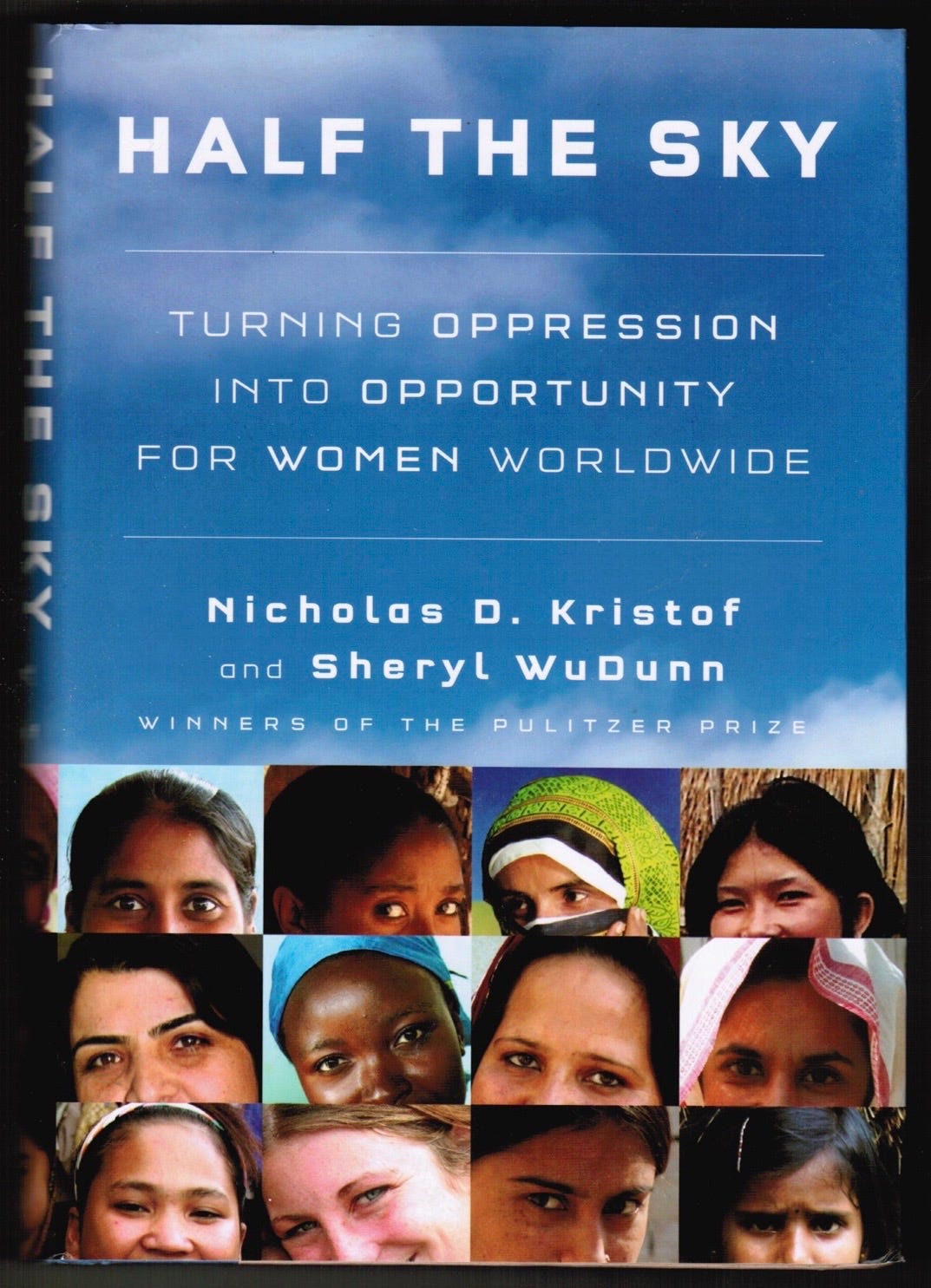
There is really no good reason to believe that any moral standard is absolute or that any ethical principle is not a product of biological and cultural evolution. The religious debaters who like to claim a God-given absolute moral foundation for morality cannot escape the fact that moral ideas change over time and from one group to another within the doctrines of any religion. Christians in the Southern United States 170 years ago, including leading preachers, believed—with plenty of biblical support for their ideas—that human slavery was not only acceptable but explicitly ordained by God. As Nicholas Kristof and Sheryl WuDunn note,
For most of history, slavery had been accepted as sad but inevitable. The Athenians were brilliant philosophers and abounded in empathy that made them wonderful writers and philosophers, yet they did not even debate their reliance on slavery. Jesus did not address slavery at all in the Gospels; Saint Paul and Aristotle accepted it; and Jewish and Islamic theologians believed in mercy toward slaves but did not question slavery itself. In the 1700s, a few Quakers vigorously denounced slavery, but they were dismissed as crackpots and had no influence. In the early 1780s, slavery was an unquestioned part of the global landscape—and then, astonishingly, within a decade, slavery was at the top of the British national agenda. The tide turned, and Britain banned the slave trade in 1807 and in 1833 became one of the first nations to emancipate its own slaves.
Other sources that make plain the failure of religions to recognize the grievous immorality of slavery or even to use religion to support slavery abound. For example, Douglas Blackmon described a wedding in 1868 in Alabama of two people who had until quite recently been slaves:
Henry was suddenly a man. Mary was a woman, a slave girl no more. Here they stood, bride and groom, before John Wesley Starr, the coarse old preacher who a blink of an eye before had spent his Sundays teaching white people that slavery was the manifestation of a human order ordained by God, and preaching to black people that theirs was a glorified place among the chickens and pigs.
It would be hard to imagine a more telling example of the disassociation of religion and morality.
In the period around and during the American Revolutionary War, Christian rhetoric was used, in Connecticut newspapers for example, both to defend and to attack the institution, in both cases invoking God as being on the side of the arguer. And R. G. Grant noted, “The rise of Christianity and Islam changed attitudes to slavery, but certainly did not end it.” Few Christians or Muslims today in America or elsewhere would attempt to defend “the peculiar institution” of slavery, though God does not seem to have issued any corrected Scriptures in the meantime. It is hard to believe that an omniscient God would not have foreseen how ambiguous his commandments are; believing that it is all up to us human beings to determine what is right, and to do it, is much easier to accept. Conscience, the critical idea on which C. S. Lewis hangs his own belief (in Mere Christianity), is much more readily understood as the product of education. The Aztec who could, in good conscience, sacrifice a virgin to the gods and the Christian Southerner who could, also in good conscience, justify owning his fellow human beings both demonstrate that consciences are not divine products.
Dan Barker wrote in Losing Faith in Faith that those of us who lack religion can say to believers,
You are an intelligent human being. Your life is valuable for its own sake. You are not second-class in the universe, deriving meaning and purpose from some other mind. You are not inherently evil—you are inherently human, possessing the positive rational potential to help make this a world of morality, peace and joy. Trust yourself.
And as philosopher Paul Kurtz has written,
Critical ethical inquiry enables us to transcend unquestioned customs, blind faith, or doctrinaire authority and to discover ethical values and principles. Humanists maintain that a higher state of moral development is reached when we go beyond unthinking habits to ethical wisdom: This includes an appreciation of the standards of excellence and an awareness of ethical principles and one’s moral responsibilities to others.
Those who support the “Big Lie” that morality depends on religiosity ignore or forget the strong biblical support for such Christian but decidedly anti-American values as accepting human slavery, denying women and children any meaningful rights at all, punishing people’s descendants for their sins, blind obedience to purportedly divine authority, unquestioning obedience even to governmental authority, giving religious ideas and leaders special rights in the name of avoiding blasphemy, and many others. Less directly biblical but nevertheless strongly associated with Christian orthodoxy are opposition to questioning authority and opposition to the healthy skepticism that is required for good science and progress in understanding the universe.
Supporters of the alleged dependence of morality on absolute religious standards also ignore human history. Horrific destruction of individuals, societies, and moral standards has certainly come at the hands of absolutist, totalitarian regimes not trumpeting Christian values—Russia’s Stalin and Cambodia’s Pol Pot, for example. But such evils have quite often come directly from Christian authorities like popes or John Calvin of Geneva and from villains like Adolf Hitler, who declared in 1926 that he was doing God’s work, that he was extending Christ’s work:
Christ was the greatest early fighter in the battle against the world enemy—the Jews. The work that Christ started but did not finish, I, Adolf Hitler, will conclude.
And Hitler counted himself a good Catholic until he died. There is considerable evidence of Christian and church support for and entanglement with the rise of Nazism.
The number of people, especially women, who have died horrible deaths because of a single Bible verse—“Do not allow a sorceress to live” (Exodus 22:18)—is unknown but huge. Both Christians and Islamic warriors committed almost unimaginable atrocities in the name of God or Allah in the Crusades. The Catholic Church itself directly engaged in torture and murder in the Inquisition. Man’s inhumanity to man has often been spurred by man trying to do God’s will.
It is worth noting that “moral values” voters in American elections are, despite apparent popular misconceptions, as likely to be voters of the right or left, of religious or secular preferences. Support for or opposition to wars and welfare programs and any other government action is certainly sometimes publicly associated with religious ideas, but the connections are rarely if ever simple or required. As Louis Menand wrote in The New Yorker, just after George W. Bush defeated John Kerry in the 2004 presidential election,
The phrase “moral values” is open to interpretive license. Peace and social justice are moral values; they just don’t happen to be values associated with the Bush Administration.
According to a review article by James Wood, Dutch primatologist Frans B. M. de Waal reports that there are sound biological reasons to conclude that religion (or “God”) is unnecessary for morality, that in fact morality developed first in human evolutionary history:
In an account of spontaneous altruism and empathy in chimpanzees—acts of “genuine kindness” that he and his researchers have recorded—de Waal speculates that human morality “must be quite a bit older than religion and civilization,” and “may in fact be older than humanity itself.”
If in fact our moral standards developed before our religious ideas did, it would seem difficult indeed to continue to support the claim that religion is needed for morality.
Those of us who lack religious beliefs should steadfastly rebut the false claims of causal correlation between religion and morality for the sake of our own reputations and social standing. But everyone, religious or not, who values individual freedom and understands that secularism is required to protect it should reject the persistent “Big Lie.” Neither logic nor historical evidence supports the idea that religiosity is even helpful, much less necessary, for ethical behavior.
Freedom for individuals is of course no guarantee of ethical behavior. But oppressing anyone on religious grounds is itself immoral and breeds much other immorality as well. The unquestionably central need for morality in any nation is served better, not less well, by a secular government in a secular society.
Note: Anyone may copy and publish what I or my guests write, provided proper credit is given, that it’s not done for commercial purposes, that I am notified of the copying (you can just leave a comment saying where the copy is being published), and provided that what we write is not quoted out of context or distorted.
Secular societies:
Denmark
Norway
Sweden
Switzerland
The United Kingdom
France
Germany
Australia
Religious societies:
Afghanistan
Pakistan
Saudi Arabia
Iran
Somalia
India
Malaysia
Indonesia
Take your pick.
A point-by-point demolition of Horn's piece will soon follow.