
Partial Repeat: Is the US Really a Free Country?
Friday, 20 March 2026

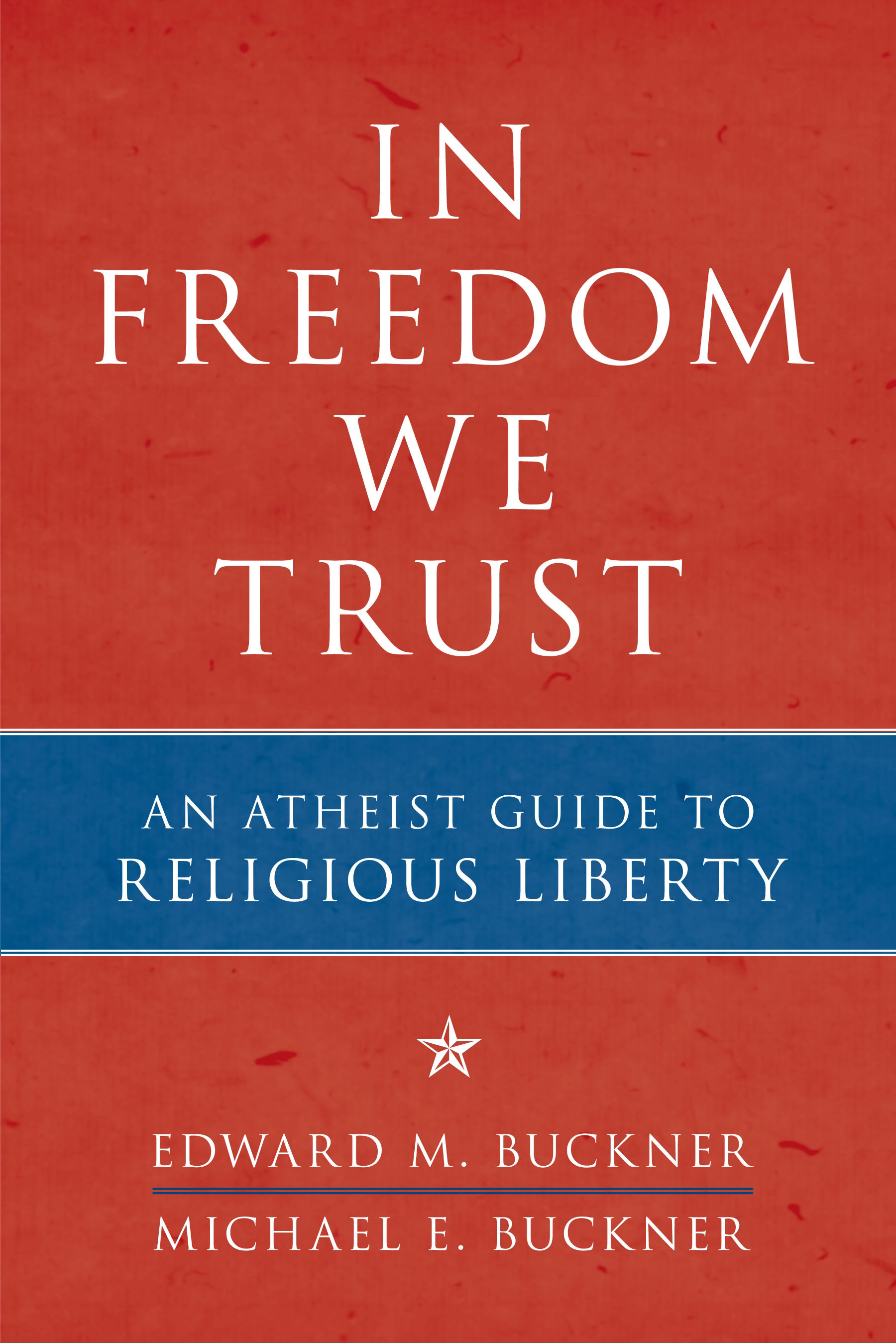
About the Friday Freethought Perennials in general: This subset of my blog is to answer questions, nearly always already answered by me and by many others but posed again and again—over many years and in many places—on freethought, atheism, secular humanism, secularism/church-state/”This is a Christian Nation,” and similar topics. These answers are mostly not intended to be original analyses, breaths of fresh air, so much as just putting a whole series of things on the record (I’d say “forever,” except I know better). One source for many of these answers is the 2012 Prometheus Books book by me and my son (Michael E. Buckner), In Freedom We Trust: An Atheist Guide to Religious Liberty. It’s available in many libraries and pretty readily in the used book after-market. I’ll cite writings of others that answer these things in more depth if I’m aware of them when I post these.
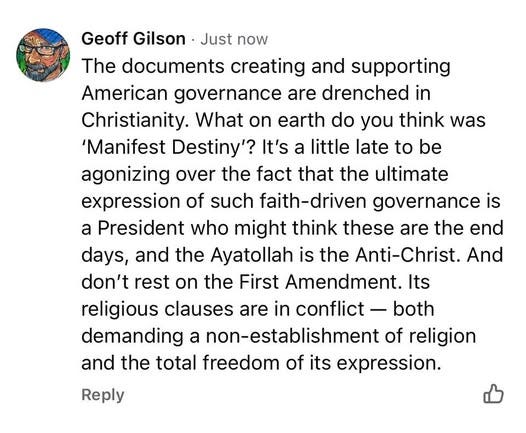
Partially a (Much Needed—See Gilson, Above) Repeat
The overall title for this whole Substack is Letters to a Free Country and the book my son Michael and I wrote a decade-and-a-half ago was titled In Freedom We Trust (Prometheus Books, 2012). Despite the subtitle of the book, it is really an American guide, one that happens to have been written by atheists.
People then and people now have questioned whether the US really is a free country, as our title for that book and mine for these Letters suggests.
My very first Letter—I January 2023—addressed that and some of this is a repeat.
Free Country—Yes and No
Formally, legally, officially, aspirationally, yes—mostly at least—this a free country.
But is a woman free to be President of the US? Not yet, apparently. Are Christians sometimes free to use the government to promote their religion? Sometimes in practice though not constitutionally. (The US Supreme Court has sometimes disagreed—but they’re mistaken. More on that another time.)
Isn’t everyone equally free, in the sense suggested by the famous words of Anatole Francein his 1894 book, The Red Lily?
The law, in its majestic equality, forbids the rich as well as the poor to sleep under bridges, to beg in the streets, and to steal bread.
And, for a democratic socialist like me, a related declaration was made by Representative Alexandria Ocasio-Cortez on Stephen Colbert’s show: “In America, no one should be too poor to live.”
And everyone remembers the last words Bat said, yes?
“We all get the same amount of ice. The rich get it in the summer. The poor get it in the winter.” —Bat Masterson, lawman and journalist, on Oct. 25, 1921.
Religious people (some irreligious ones, too) sometimes suggest that they’re not free if they cannot require others to accept their ideas or at least to stand to the side, quietly and respectfully, while the religionists use government resources to promote or privilege those ideas. (More on this subject later.)
Limits on Freedom
But any idea of freedom in a nation or even just in a neighborhood group requires some limits. It’s plainly unreasonable for me to declare that I’m not free unless I can wander into your house and eat your food or kill one of your pets whenever I want.
As my son and I wrote in our book,
Fundamentally, all citizens of the United States are free (and Christian only if as individuals they choose to be Christian) because the Constitution of the United States, the supreme law of the land, establishes that. As the Constitution is the legal foundational document of the United States, for the United States to be a Christian nation (or a Buddhist nation, or a Masonic nation, or a monarchy), it would have to be declared in the Constitution. But not only does the Constitution fail to establish the United States as a Christian nation, it specifically avows that “under the United States” “no religious test” is allowed (Article VI), and it guarantees equal religious liberty to all with only a few exceptions (if your religion tells you that it is desirable to harm someone else, you will not be free to do that in this country)—it establishes the United States as a free country right from the start.
But these Letters are not just about the constitution and religious liberty (plenty on those subjects for sure). These epistles turn on the valuable ability of all of us to be free—to think, to disagree, to assert things (and defend them if we choose), to be interested in different things, and to change our minds.
On Fridays, the post will usually be on matters of freethought, religion, secularism, atheism, and related things.
(Next Friday, 27 March 2026, the Letter will return to the 1796-1797 Treaty of Tripoli that prominently included the accurate statement, “. . . the government of the United States of America is not in any sense founded on the Christian Religion”—and the subtleties related to that—in honor of Geoff Gilson. And on the Friday after that—on 3 April—I’ll tell Geoff and others exactly how to beat me in this debate over Christian nation-hood.)
On other days (Mondays, at least), the focus will be less constrained. And every day, all readers will be invited to agree or disagree and to say so in the comments. (So don’t worry too much about being careful what you say—though please avoid personal insults, extended preaching, rants, and invective.)
I already have subscribers who I know have major disagreements with me over politics, religion, and other important things—and I count all the ones I know in these categories as friends or loved ones and want to keep them as friends and loved ones.
I’ll mix it up, with opinion, analysis, an occasional explanation of something I have some expertise on (the Bible or statistical significance), and, once in a while (mostly on Wednesdays), I’ll invite a friend to say a few words. One frequent guest has been and will be philosopher Keith Parsons with a brilliant essay. And I harbor fond hopes of browbeating my favorite writer, my son Michael, into offering his views more—maybe even on the one significant set of issues, gun control, on which he’s wrong—er, uh, I mean on which we disagree. And he knows more history than I do, too (and that may turn out to be the basis for one of my posts).
Secularism
There are many topics still to be covered with my Letters, but let me introduce here the one I may know the most about: secularism. The rest of this Letter is a summary, inspired as a partial repeat here by Geoff Gilson’s Facebook post—see that near the top of this Letter—but in fact this was mostly published already in our 2012 book.
The US is and Should Remain a Free Country and not a Christian Nation
In any but a superficial sense, the United States is not and should not become a Christian nation. Atheist though I am, I do not think it is or should become an atheist nation, either. Atheists as individual citizens can argue against religion and work to reduce its power and influence; individual religious citizens can similarly argue for their religious views and freely promote those ideas—but not through government.
I do not argue that religion is merely a private matter nor do I say that religious ideas should not be brought into the public square or the marketplace of ideas. I only argue that any idea, religious or not, should not be brought into the public sphere unless criticism of it is welcome. Political ideals may certainly be rooted in religious beliefs, but in a democratic society proponents of public policies must be prepared to defend those ideas in terms that go beyond mere assertions of God’s alleged will. To put it another way, anyone seeking to change public policy must understand that in our secular government, saying “God says it should be this way” is never a sufficient basis for adopting or changing a policy, regardless of how deeply held and sincere the religious belief that underlies the statement. Secular means nonreligious, not anti-religious, and a government that works to support or to undercut religious ideas or that urges its citizens to be religious or to avoid religiosity is dangerous to religious liberty for anyone.
American secularism is not, despite loud and fierce claims to the contrary, some sort of atheism protection racket, an anti-religion subterfuge, or a protect-the-feelings-of-overly-sensitive-atheists scheme. It is instead the only approach that can consistently secure religious liberty for all.
An example that is instructive recently happened in New York City. The Freedom From Religion Foundation (FFRF), an atheist group of which I’m a proud life member, took the mayor to task for using the auspices of city government to promote a religion:
https://ffrf.org/news/releases/ffrf-warns-nyc-mayor-mamdani-over-religious-ritual-with-municipal-workers/
This happens to be one example that even the most ardent Christian Nationalist would probably agree with FFRF on: Mayor Mamdani was allowing his staff to use city government to promote Islam (they likely claimed it was only indirectly, but it’s still unacceptable). Of course FFRF is wholly correct in this, but the complaint that Christians might approve of here—since it is seemingly anti-Islamic—has exactly the same logic as the many complaints FFRF (and others) have lodged against government support for Christianity.
There really is no middle ground here: either governments have the power to make religious decisions for citizens, or governments lack that power. As James Madison, later to act as “the father of the Constitution,” summed up nicely the core of the argument:
Who does not see that the same authority which can establish Christianity in exclusion of all other religions may establish, with the same ease, any particular sect of Christians in exclusion of all other sects?
And please note: Muslims should agree with FFRF even in this case. No self-respecting American Muslim should want New York City government to decide what is the correct way to celebrate Ramadan or any other ritual.
Freedom Worth Protecting
Freedom, especially religious liberty, is worth having and protecting. This seems self-evident to most of us, regardless of our religious or irreligious beliefs. The American ideal is not, despite myths and misconceptions held by many, of all religious and political persuasions, pure majoritarian democracy. Nor is the core ideal that has made America strong, a beacon to individuals and nations everywhere, tied to any religious idea.
The evidence and logic is overwhelming: If you thought that America is or ought to be a Christian nation, then what you thought was wrong and you should change your mind, if only for selfish reasons. To guarantee your own religious liberty, you really do have to help protect everyone else’s, too.
The secularism at the heart of American liberty, established by the authors of the US Constitution (including the First Amendment and extended by the Fourteenth Amendment) is compatible with a wide range of political philosophies, from doctrinaire libertarianism to democratic socialism, from true conservatism to left-of-center progressivism. It is compatible with most nonreligious viewpoints and most religions. If a religion requires its adherents to involve government in supporting the religion to any degree, to that degree American secularism will be unacceptable to its followers. Such secularism is not compatible with theocratic, statist, or other forms of absolutist, authoritarian government.
For all who agree with us that secularism is the only way forward, the only proper ideal for securing religious liberty and domestic tranquility in America, the question now is what must be done to protect secularism. The answers are multiple and depend in some cases on the individual’s own political or religious preferences. All should support the work of national organizations such as Americans United for Separation of Church and State. Each nonreligious American should work within and support national organizations like American Atheists, the Council for Secular Humanism, the American Humanist Association, the Richard Dawkins Foundation, and the Freedom From Religion Foundation and with local or regional groups as well. For secularists, especially those of the irreligious sort, support the strategic plan laid out in Sean Faircloth’s Attack of the Theocrats. Religious Americans should work within the mainstream church that best matches their religious beliefs to insist on secularism and support for it. And religious American citizens should support Americans United or even atheist groups like FFRF when these groups support secularism.
Letters to editors of all sorts of publications will help, especially when false arguments or facts in need of correction appear in those publications. Knowing the facts, the history and the logic, that support secularism and then speaking up, cordially but firmly, in public debates (formal or just at the workplace water cooler) is essential. Silence will generally be assumed to be consent—and we must speak up. Lobbying steadfastly for real neutrality in government at all levels and in public schools must be continual, as must be pressure for accurate curricular materials in schools everywhere. National organizations like the Secular Coalition for America can help in this.
The quintessentially American ideal is not to trust in the government, nor in any party or religious authority, nor in ay President, nor in any charter or document, but instead in a democratic republic, a society where no authority ultimately trumps the inalienable rights of every individual. Americans should not blindly trust in Washington, DC. I do not unthinkingly trust in the Declaration of Independence or even in the Constitution of the United States (including the Bill of Rights). And we do not rely on or, as a nation, call on, or trust in any God. We rely instead on competing ideas and competing individuals, with careful safeguards for the rights of every individual, no matter what any of them think or say or believe.
E pluribus unum—out of the many, one.
In freedom we trust.
Note: Anyone may copy and publish what I or my guests write, provided proper credit is given, that it’s not done for commercial purposes, that I am notified of the copying (you can just leave a comment saying where the copy is being published), and provided that what we write is not quoted out of context or distorted.
"Manifest destiny" appears nowhere in the founding documents. According to Google AI, the phrase was coined by journalist and editor John O'Sullivan in 1845 to justify American expansionism. The name O'Sullivan appers to indicate Irish ancestry. I wonder how he would feel about England's manifest destiny to rule Scotland, Wales, and Ireland.
As always, thank you dr. Ed,