
Kevin McNamara: Part Two
Guest Letter, Part Two, Saturday, 11 July

The Making of Americas, Part Deux
This is the West, sir. When the legend becomes fact, print the legend.
The Man Who Shot Liberty Valance
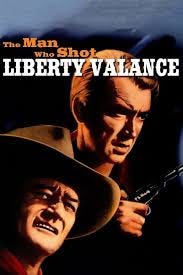
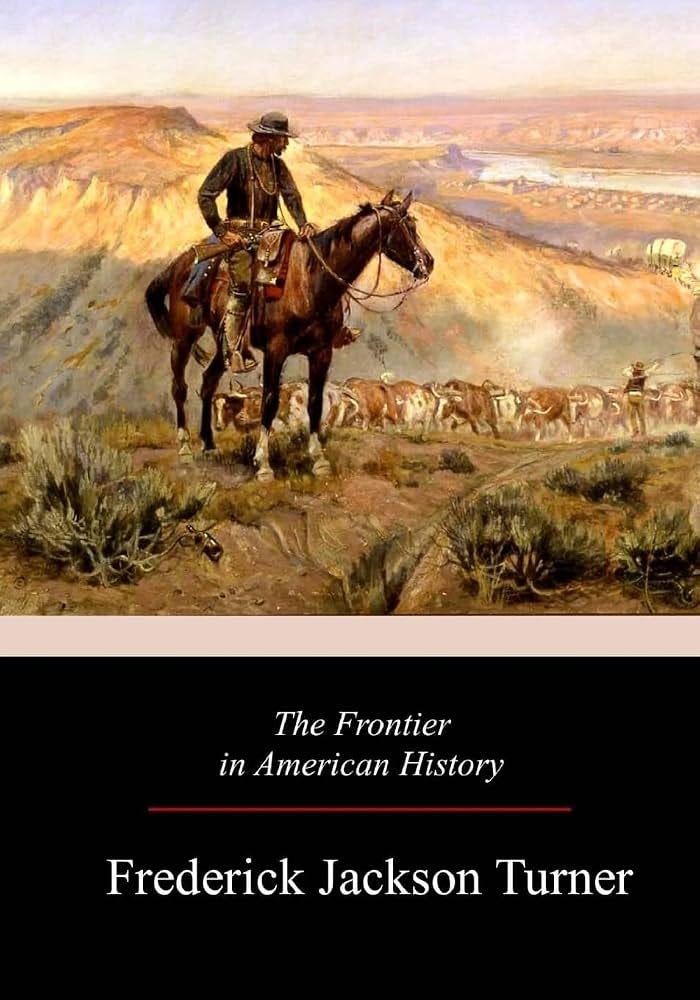
On first reading “Significance of the Frontier” (1893) by Frederick Jackson Turner (1861-1932), I sensed a clever way to reorient American history from the festering wounds of slavery to the destiny of American empire because even as the continental frontier had vanished, Hawaii, the Philippines, and other points west (East?) beckoned. I’ve not renounced that view, but a career studying American mythology and literary history, taught me that the Badger Stater was celebrating the primal divide in US culture, between the agrarian, egalitarian, landscape of American exceptionalism and the mongrel, hierarchical industrial cityscapes of the seaboard.
In Part One, I noted Jefferson’s adoption of the yeoman to represent the exceptional nation. Obviously, slavery did a lot of work to efface very real differences between actual yeoman farms and, say, Jefferson’s Monticello; even Crèvecoeur’s iconic American farmer, “melted into a new race” as he headed inland and exchanged his “ancient prejudices and manners” for the local values, owned slaves.1 However unnerving slave revolt might be, Jefferson feared cities more because they house propertyless laborers capable of ferment. No more than Locke did he consider them rational. Thus, Jefferson particularly despised Hamilton, architect of First Bank of the United States and Society for Establishing Useful Manufactures, and advocate for importing Gastarbeiter to whom he would not offer citizenship. For generations of historians, the stake of their battle was the nation’s exceptionalism.
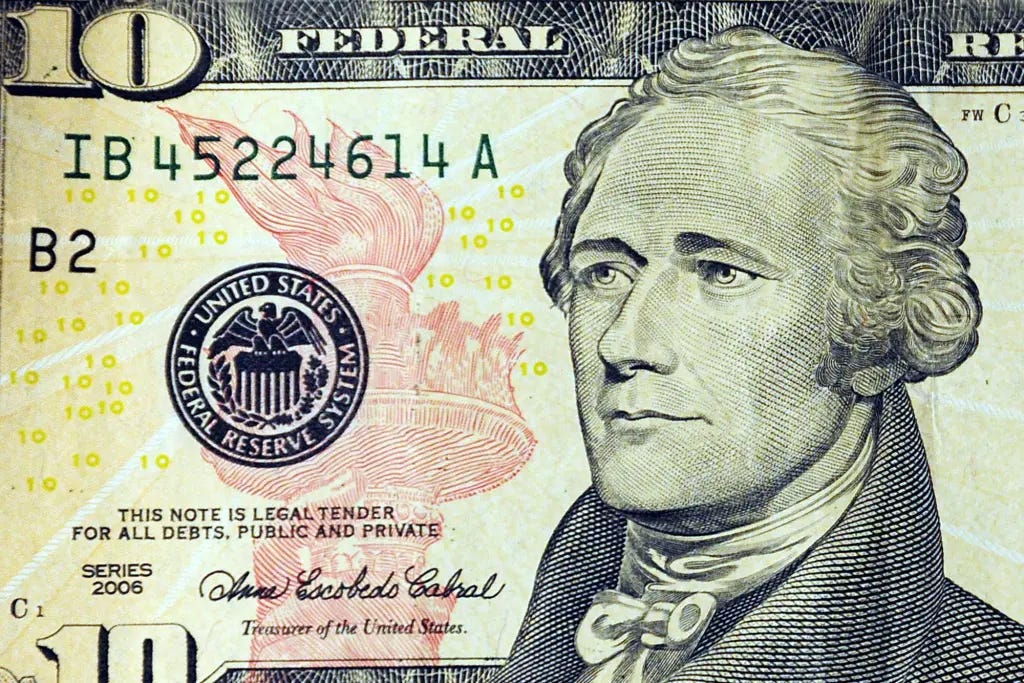
Alexander Hamilton (1755 or 1757-1804 [from duel with Aaron Burr])
Turner’s gambit was to save exceptionalism and individualism after the open land had disappeared. Revising Crèvecoeur with dime Western tropes, he imagined the land “stripp[ing] off the garments of civilization and array[ing the frontiersman] in the hunting shirt and the moccasin. […] planting Indian corn and plowing with a sharp stick; he shouts the war cry and takes the scalp in orthodox Indian fashion.” The products of this encounter weren’t sentimental farmers. These were fierce democrats whose “impulses [are] stronger, their wills less restrained” than their seaboard cousins. Among them he numbered not only the Sage of Monticello, but Andrew Carnegie, Mark Hanna, John D. Rockefeller, and other Gilded Age titans who hailed from the West or moved there. Their ways (ruthless capitalism and exploitation of natural resources, perhaps?) were proof that frontier character had been so “wrought into the very warp and woof of American thought” that it would survive industrialization.2
Early and mid-twentieth century scholars balked at Turner’s embrace of the Robber Barons. Even so, they looked West. V. L. Parrington’s magisterial, unfinished, Main Currents of American Thought (3 vols., 1930) tells US history as a conflict of Jeffersonian and Hamiltonian forces. Three American Studies landmarks of the Postwar Consensus Era, Henry Nash Smith’s Virgin Land: The American West as Symbol and Myth (1950), Robert Spiller’s The Cycle of American Literature (1955), and Leo Marx’s The Machine in the Garden : Technology and the Pastoral Ideal in America (1964 – titled from a scene in Thoreau’s Walden [1854]) root American promise in the unclaimed land that promised liberty and a fresh start, the garden of the West, Smith called it. Spiller’s literary history recounts two rolling frontiers, the settler-colonialist “conquest of the continent” and establishment of the agrarian nation, then the machine’s subsequent conquest of “the garden of the world in the West” foreshadowed by the scenes Marx reads.3
Parrington asks us to imagine Jefferson, contemptuously “look[ing] into the future[, where] he saw great cities rising to breed their Roman mobs, duped and exploited by demagogues, the convenient tools of autocracy and count[ed] the cost in social-well-being.”4 And here they are! Except that the red-hatted mob hails largely from the townships and hamlets. What happened?
The first thing to say is that none of those four men were nostalgists, unlike the Southern Agrarians (Robert Penn Warren, John Crowe Ransom, and Allen Tate among them) who defended the Lost Cause in I’ll Take My Stand (1930). Parrington abhorred capitalism. Smith, as he entered his 60s, participated in the Free Speech and Antiwar movements at Berkley. Marx at least flirted with socialism and became an early ecocritic. Their interest in the nineteenth-century American West was to resuscitate a native, egalitarian, democratic tradition to oppose industrial capitalism’s concentrations of wealth and power.
That endeavor faced several problems. Firstly, proclaiming a unified American character and values meant overlooking much, including slavery (except as abolition), the ethnic cleansing of the West, the instability caused by rampant speculation in Western land that led to numerous bank-runs and the Panics of 1837 and 1857. Secondly, the ideal American remained a mixture of northern European Christians. Thirdly, the literary historians implied that industrialism was not inevitable, although not even farmers could avoid it—they were at the mercy of the railroads, futures markets, and global commodity trading (see Frank Norris’s novels The Octopus [1901] and The Pit [1903]). Finally, they trafficked in myths and symbols that conservative cultural forces had already deployed—not to transform the present but to refuse modernity and difference in most all of its forms.
By the time he died, Parrington—whose subject was cultural history—recognized the trap he had set for himself. Much of Main Currents’ third volume reads bitter because he had to concede that the nation had never been an egalitarian democracy, that individualism lacked the resources to improve workers’ lots, and that his yeoman hero was a fiction. The Constitution was rigged in favor of property, Charles Beard and others had taught him. Only in league could industrial laborers effectively secure better wages and working conditions. Farmers relied on The Grange and other collectives. To his credit, Parrington attempted to transfer agency to unions, a collective hero that would drive some experimental novels of the 30s, but interdependence and the necessarily fragmented character of urban life cut against much that he held dear. Turning on the yeoman hero, Parrington concludes that “he had never been a land-loving peasant, rooted to the soil and thriving only in daily contact with familiar acres.” Rather, he “had long been half middle-class, accounting unearned increment the most profitable crop, and buying and selling land as if it were calico.”5
It didn’t have to be this way. Already, city and country were deeply imbricated. Already, the art, architecture, and literature of American cities provided a rich store of cultural symbols celebrating American promise and challenges met. We forget, but Walt Whitman was a brilliant poet of the seductions of city life, as well as a serious thinker about the nature of the Democratic ethos required for this vast nation of nations. Fitzgerald’s The Great Gatsby (1925) is too often read as condemning the East, but an attentive reader finds a more complex set of feelings, including a recognition that the exceptional nation was always already corrupt. Immigrant and Realist literature, as well as the urban sociology of the Chicago School, Jane Addams and other early theorists of pluralist (Horace Kallen) or more forthrightly multicultural (Randolph Bourne) America offer a frame for thinking about pressing national issues that Western idylls evade and the immigration regime of 1920–1965 sought to reverse. But cities were deemed insufficiently American.
Confronting facts remains a problem. A June PRRI poll showed that 89 percent of Americans say that accepting diversity is a core value. Nevertheless, 34 percent prefer a primarily Christian nation and 20 percent a population primarily from Northwestern Europe. Those numbers do not add up. Likewise, Americans claim to love democracy but tend to hate politics because it is rooted in conflict and requires confronting differences that expose inequality and implicate us in each other’s lives, ideas anathema to American constructions of individualism and freedom. “So,” to repurpose Scott Fitzgerald, “we beat on, boats against the current, borne back ceaselessly into the past.”6
____________________
NOTES
1 J. Hector St. John de Crèvecoeur, Letter III, Letters from an American Farmer (Mineola, NY: Dover, 2005), p. 26. Inland for Crèvecoeur was Chester, New York.
2 Frederick Jackson Turner, The Frontier in American History (New York: Henry Holt, 1921), pp. 4, 34, 264.
3 Robert E. Spiller, The Cycle of American Literature: An Essay in Historical Criticism (New York: Macmillan, 1955), pp. x, 105.
4 Vernon Louis Parrington, Main Currents in American Thought: An Interpretation of American Literature from the Beginnings to 1920, 3 vols. (New York: Harcourt, 1930), 1:346.
5 Parrington, 3:26.
6 F. Scott Fitzgerald, The Great Gatsby (New York: Scribner’s, 1925), 218.
For a summary of the PRRI poll, see

I am less sanguine than Ms. Rubin.
Note: Anyone may copy and publish what I or my guests write, provided proper credit is given, that it’s not done for commercial purposes, that I am notified of the copying (you can just leave a comment saying where the copy is being published), and provided that what we write is not quoted out of context or distorted.
Thanks again for reading Letters . . . . Subscribe for free (always) to receive new posts and support my work.
Another essay of remarkable erudition and richness.
The myth of the frontier was never more powerful than in the popular culture I encountered in childhood (fifties and early sixties). About 90% of the TV shows were westerns. The Rifleman with Chuck Connors as Lucas McCain was the paradigm. The archetypical American was a strong, independent man, one with a strong sense of fairness, a dedication to hard work, and, though not temperamentally violent, a formidable opponent if engaged. The TV westerns inculcated the theme that the American West from 1870 to 1890 was where true American values were expressed to the highest degree. Good and evil were clearly distinguished and the bad guys were dependably vanquished by the sheriff's quick draw and sure shot. Native Americans were irrelevant or hostile. Only a few productions, like John Ford's Cheyenne Autumn (1964) portrayed them sympathetically. By the late sixties, with the exception of holdouts like Bonanza and Gunsmoke, the westerns had largely disappeared. Recent westerns, like Netflix's American Primeval present a frontier diametrically opposed to the one depicted in the old TV westerns--a west that is brutal and viciously violent. So, has the myth of the frontier finally atrophied?