
Keith Parsons--War!
Guest Letter--Tuesday, 24 March 2026

I don’t usually post guest Letters on Tuesday, but this one couldn’t wait. And I’m going to post another of his tomorrow—and maybe even still another on Thursday—he’s writing well and often.
War! HUH! WHAT IS IT GOOD FOR?
Keith Parsons

Wars have been fought for all sorts of reasons, some of them ridiculous. In Gulliver’s Travels (1726), Jonathan Swift lampoons wars for stupid reasons by having Lilliput go to war with its neighbor Belfuscu over which end to open a boiled egg. Real wars have been fought for equally absurd reasons. From 1998 to 2000, Ethiopia and Eritrea fought a war that killed tens of thousands on each side in a dispute over who should own a miserable chunk of desert. Swift considered wars over religious differences to be the most absurd.
Wars have been fought because of ego. A king or emperor, wishing to enhance his own glory, would decide that his personal pomp would be best served by grabbing a slice of a neighbor’s territory. In 1667, the young Louis XIV was feeling his oats and, seeing that the Spanish were weak, decided he wanted to grab the Spanish Netherlands, currently Belgium. He was opposed by the Dutch, who offered to partition Belgium, but, according to Colin McEvedy in The Penguin Atlas of Modern History, “...this was not Louis’ way—no one was to share his glory—he invaded Belgium on his own account (p. 50).” Probably the most inexcusable reason for starting a war is to serve some autocrat’s ego. We are most fortunate that this does not happen anymore.
These are among the reasons that wars have been fought: To gain or regain territory, the defense of territorial claims, to become an independent, self-determining entity, to prevent secession (e.g., the American Civil War), to oppose an all-out invasion (e.g., the Greek opposition to the invasion of Xerxes), because you are viciously attacked (Pearl Harbor, 9/11, 10/7), coming to the aid of an ally that has been attacked, to serve an ideological or religious mandate (e.g., Hitler’s quest for Lebensraum; the Crusades effort to “free” the Holy Land), failure to satisfy an ultimatum (e.g., Austria’s attack on Serbia initiating the First World War), nationalism, imperialistic ambitions, to keep making money (e.g., the Opium Wars), to eliminate a competitor (e.g., Rome’s wars against Carthage), and many more.
Are any of these good reasons? Obviously, the Greeks defending themselves against Xerxes and the Russians defending against Hitler were fighting justly. When a foreign power invades with plans to enslave or murder you, your cause is righteous. Also a vicious attack, like Pearl Harbor or the 10/7 attacks on Israel, are unquestionably a casus belli. Nationalism, the desire of a people—defined by culture, language, history, and often ethnicity—to rule themselves can also be a reasonable justification for wars of liberation (but not terrorism). Thus, rebellion against colonial rule is justifiable. When the French attempted to reimpose colonial rule on Vietnam after WWII, the Vietnamese rightly fought them, and at Dien Bien Phu in 1954, they handed the French their derrières. (Shamefully, the US supported the French, and, worse, failed to learn the salutary lesson of their defeat.)
In my lifetime, and ignoring “minor” incursions like Panama, the Dominican Republic, and Grenada, the wars that the United States have fought have been: Korea, Vietnam, First Gulf, Second Gulf, Afghanistan, Iran. Of these, the only ones I regard as unambiguously justified are Korea and the First Gulf wars. In each case, our involvement was prompted by unprovoked aggression and our participation was part of a broad international coalition and supported by the United Nations. Vietnam, the Second Gulf War (the Bush/Cheney war of choice), and the current Iran War (the Trump war of ego), were (are) clearly unjustified. The war in Afghanistan is ambiguous. The attack on al Qaida and their Taliban enablers was surely justified, but this was the beginning of the paradigm “forever war” where we repeated the same mistakes made in Vietnam and, in the end, with the same dismal results (see the excellent Netflix documentary series Turning Point: The War on Terror).
One lesson we may clearly learn from these wars of my lifetime is that we do not learn from wars. Thucydides studied the Peloponnesian War to learn the stern lessons of “the school of history.” The United States clearly flunked out of that school. My guess is that we are invincibly ignorant because we are so powerful. We can project dominant force on land, sea, and in the air. We have superior technology, firepower, equipment, training, intelligence, logistics, mobility, and command and control.
In 2017, B-2 Spirit stealth bombers flew nonstop from Whiteman AFB in Missouri to Libya and dropped 100 guided bombs on two ISIS training facilities, killing 100 terrorists. That is one 500 pound bomb for each one killed. We can do this. You would have to be a fool to fight the United States, right? Yet in Vietnam, and currently in Iran, we were/are the fools. For Iran, as for Vietnam, to win they do not have to win any battles. All they have to do is survive. Trump’s fantasies of regime change has produced a new Iranian boss. Same as the old boss.
IF we could learn from past wars, what should we learn? First, we have to realize that being overwhelmingly powerful does not mean that we can simply impose our will. The other side gets a vote. Sure, we can knock the shit out of them. We dropped more total tonnage of bombs on Vietnam than were dropped in every theater in WWII. Fat lot of good that did us. In the current war against Iran, we can blow up anything we please. That has not stopped Iran from hurting us and hurting the whole region. No end of their ability to inflict deadly harm is in sight. When you throw a rock at a hornet’s nest, the hornets decide when it is over.
Second, we have to learn that the enemy cannot be expected to think rationally. In the Second World War, by spring 1945, it was clear that Germany was beaten, yet they continued to fight savagely (If you like war movies, check out Fury with Brad Pitt.). To stop them, the Soviets had to physically occupy Berlin. The cost was terrible. The battle for Berlin cost over 360,000 Soviet casualties. You cannot expect the enemy to see things your way. You have to make them stop by destroying their ability to wage war. To do that is going to be very costly and require massive amounts of infantry, armor, and artillery. Sure, we can change the Iranian regime. We just have to occupy Tehran. The Iranians will fight as savagely as the Germans did. Anyone care to guess what the butcher’s bill would be?
If you are not willing to do what it takes to end the war, don’t start it.
Another lesson is this: The American people generally don’t want war unless the war has been brought to us, as with Pearl Harbor and 9/11. Our leaders, however, often do want war much more than we do. To justify the cost in money and lives, they will tell us the most outrageous and egregious lies. Consider the shameful history of lies the government has told us to justify wars: The Gulf of Tonkin “incident,” that the Vietnam war was winnable (long after they knew it was not). We had turned the corner. There was light at the end of the tunnel. Body counts proved we were winning. Saddam had connections with al Qaida. Saddam had weapons of mass destruction to rain on the United States. The smoking gun would be a mushroom cloud. Iran, whose capacity to produce nuclear weapons was totally obliterated just a few months ago, is now just about to unleash nuclear mayhem. The new Iranian ruler will be friendly towards us.
When Condi Rice would testify before Congress to offer junk justifications for the Bush/Cheney War of Choice, you could see her inner conflict playing out on her face. Clearly, her conscience was shouting with a bullhorn. Watching, I would plead, “Tell the truth, Condi! I know there is good in you! Don’t give in to the dark side!” But she would always go ahead and lie anyway—through clenched teeth. What doth it profit a woman to hold a prestigious cabinet position and to lose her own soul?
Finally, and most importantly, we have to face up to what we have done to make other nations want to fight us. In 1953, Mohammed Mossadegh was the democratically elected prime minister of Iran. While in parliament, Mossadegh had led the effort to nationalize the British-owned Anglo-Iranian Oil Company. Fearful of the loss of further assets, the British began punitive operations against Iran. President Truman refused to go along with British plans to unseat Mossadegh, but Dwight Eisenhower agreed and initiated Operation Ajax to orchestrate a coup against Mossadegh.
The coup succeeded and Mossadegh was expelled. The hated Shah Reza Pahlavi was returned to power. Pahlavi was an authoritarian who ruled brutally. His secret police, SAVAK, would arrest, imprison, and torture the Shah’s opponents, producing deep resentment among the Iranian people. When the despotic Shah was finally driven out in 1979 and the ayatollahs took over, is it any wonder that the Iranians did not feel well disposed towards the Great Satan? Mind you, I do not think that the Iranians were justified in taking the hostages, but we do have to face the fact that we continue to this day to pay the price for the CIA skullduggery of over seventy years ago. If your actions are devilish, don’t be surprised if your victims regard you as Satan.
Speaking of skullduggery, when I visited the Ecuadorean Parliament in Quito, a lavish mural decorated the wall of the meeting chamber. A figure in the mural was a skull with “CIA” printed across the forehead.
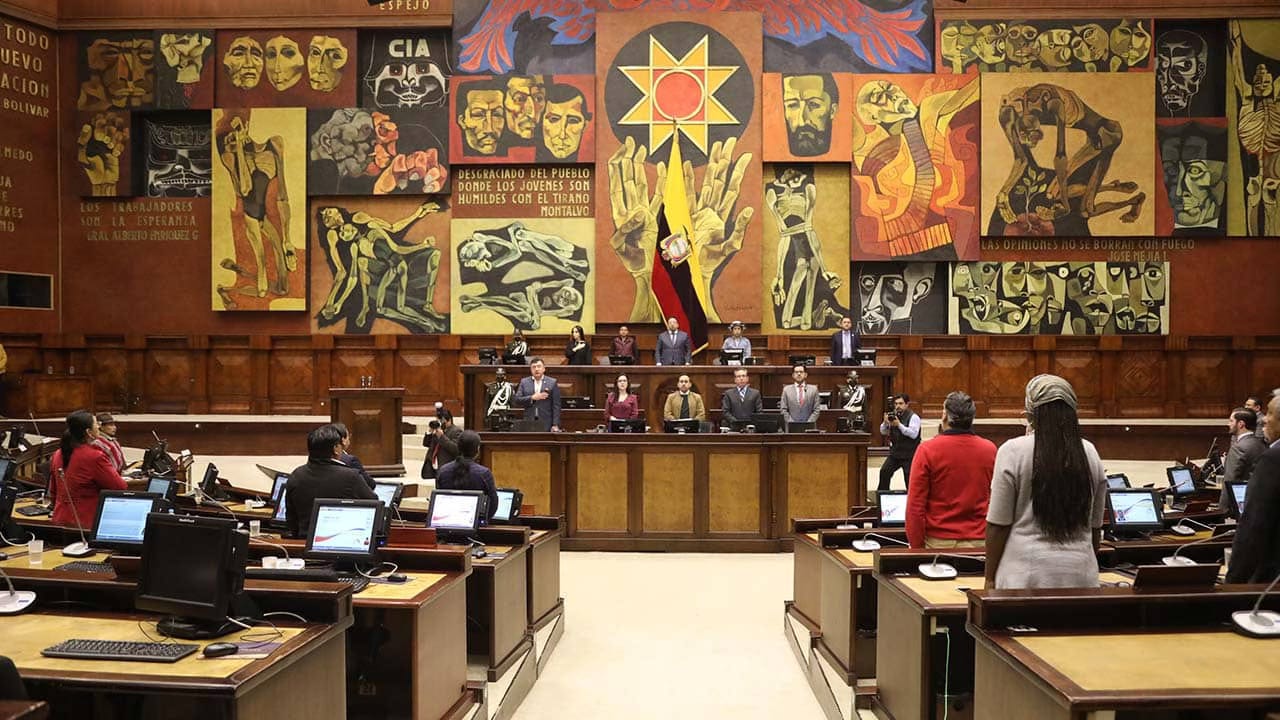
Yep. Nobody to blame here but ourselves.
Wars sometimes have to be fought. There will be wars and rumors of wars, if not for all time, at least for the foreseeable future. I am very hawkish for a liberal. I think we should have the best military we can afford. It should be the best in the world. True, for what you spend on guns, you could buy a lot of butter. But if you do not have guns, you will not be able to keep the butter you have.
What is the upshot? We must have a military that is ready to respond anywhere in the world at any time. However, unlike Trump’s pet slug Stephen Miller, we cannot justify military force by appeal to “might is right.” Here is what The Council on Foreign Relations reported of Miller’s interview with Jake Tapper on CNN:
As Miller told CNN’s Jake Tapper on Monday: “We live in a world in which you can talk all you want about international niceties and everything else, but we live in a world—in the real world, Jake—that is governed by strength, that is governed by force, that is governed by power. These are the iron laws of the world that have existed since the beginning of time.” https://www.cfr.org/articles/getting-might-right
As a statement of what has in fact happened in history, Miller, of course, is right. Miller is only saying what, according to Thucydides, the Athenians said to the Melians before massacring them. The powerful demand what they will and the weak suffer what they must. Justice is irrelevant. However, here is another fact of history: Those who do terrible things must often pay a terrible price. The Assyrians were the Nazis of the ancient world. They created an empire based on terror, and even raised steles to boast of their atrocities. However, they created such hate, that, when their enemies finally destroyed them, they destroyed them utterly. Czar Nicholas II responded to growing unrest with more despotism. He and his whole family paid the price in a basement in Yekaterinburg.
Enemies have long memories, especially in the Middle East. We think in terms of years; Middle Eastern people think in terms of millennia. If you treat people unjustly, do not expect justice or mercy to be shown to you.
Further, as the Iranian War is teaching us, being the most powerful does not mean you cannot be hurt.
Note: Anyone may copy and publish what I or my guests write, provided proper credit is given, that it’s not done for commercial purposes, that I am notified of the copying (you can just leave a comment saying where the copy is being published), and provided that what we write is not quoted out of context or distorted.
Thanks again for reading Letters … . Subscribe for free (always) to receive new posts and support my work.
I agree with most of your statements. However, what about war to prevent a bigger disaster ? I think that the war in Iran is right but initiated for all wrong reasons. Actually, a much smaller war or even strong diplomatic measures 20 years ago could prevent it. However, Iran has a strong religious reason for a war against everybody (Sunni Muslims, Christians, Jews). Just think about 10 years from now - how many ballistic missiles they could have and might be nuclear warheads as well. Just think on religious wars in Europe -- if they would have the destruction power of today weapon? Is there any justification for a prevention war that might reduce chances for a much bigger one? I think that currently you provided a Western point of view on history, which assumes some rational thinking and moral foundations. Sorry for a long comment
Sure, the US and Russian involvement in WW !! was justified, though in both cases it would have been justified before the attack-- tho US neutrality was "less worse" than the Hitler-Stalin pact.
Israel's response to the 10/7 attack was justified, but if fighting against colonial powers is also legit, and the weaker has pretty much to use any means necessary, than so is the 10/7 attack. Or, if you prefer, both were are crimes.
Don't forget Afghanistan, 20 years of fighting to overthrow the Taliban and put them back in charge. Only fair since we created the opportunity for their initial takeover during the Cold War. (Yes, the US was mostly backing the Northern Alliance against the Taliban as the legitimate government, when it thought about it, but the NA's primary aid came from, wait for it, Iran.)
What a tangled web we weave / go 'round with circumstance ...