
Keith Parsons: Godzilla!
Wednesday--10 December 2025

Another great guest Letter:
GODZILLA! RUN FOR LIFE!
Keith Parsons
My family was late getting a TV—not until 1959 by which time forests of aluminum antennae had sprung up on rooftops across the country. We settled for “rabbit ears,” extendable antennae on top of the TV, which gave an acceptable picture if adjusted carefully. In those days, TV reception was rather fragile. A passing aircraft could make the picture go funny. The screen was prone to roll and periodically the vertical had to be adjusted. Also, nearly all TVs were black-and-white. Yet the TV was a wonder box, bringing you thrills that you had never imagined.
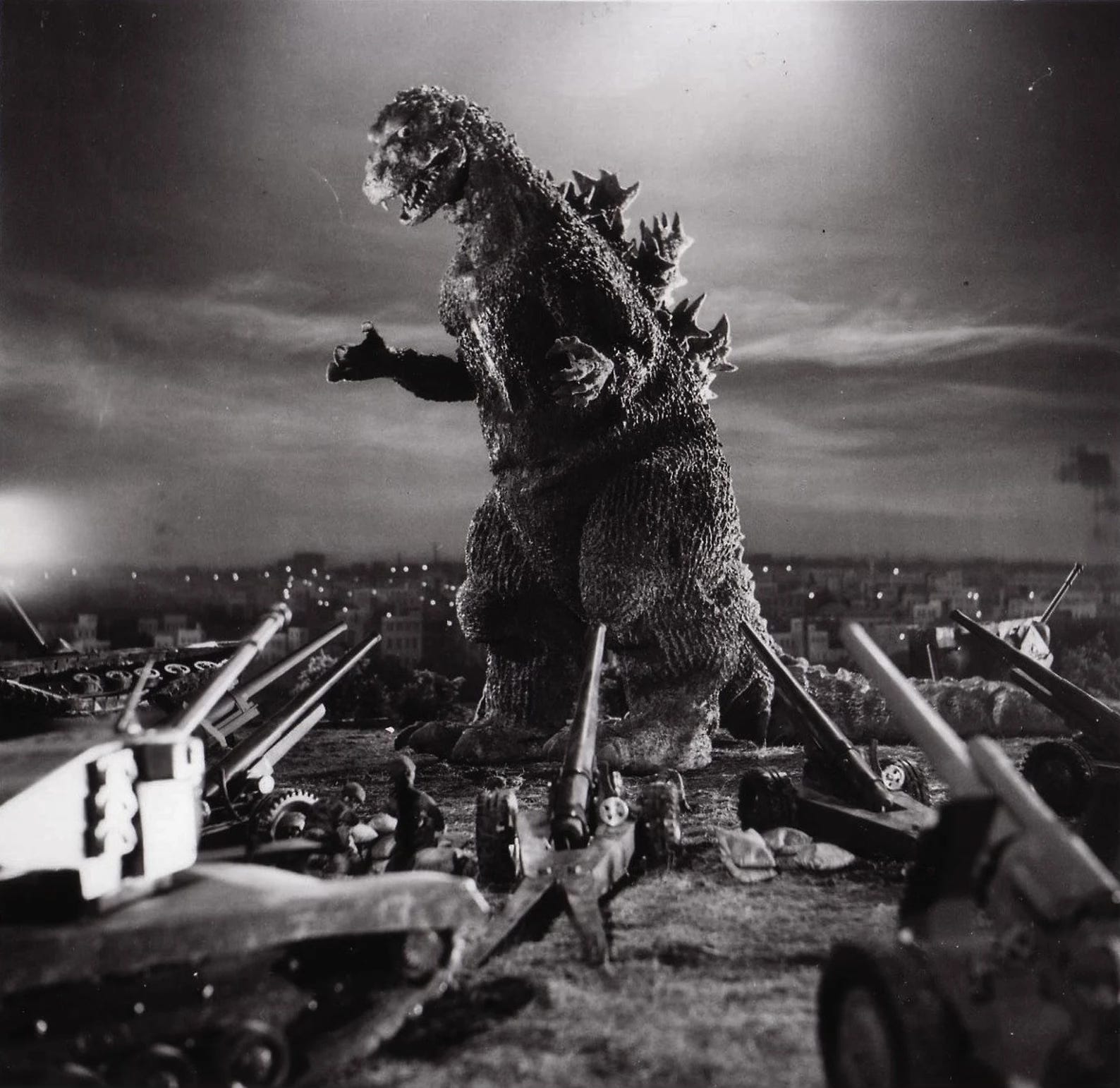
At some point when I was seven—so in 1959 or 1960—A local station carried Godzilla (1955). The English was badly dubbed with the Japanese actors’ mouth motions not at all matching the dialogue. Scenes with the American actor Raymond Burr had been clumsily spliced into the original Japanese film, making the narrative odd to say the least. Yet from the first sight of Godzilla, I was hooked. Godzilla was said to be on the other side of the island, just behind the big mountain. The islanders all were running up the mountain to see when Godzilla, unbelievably huge and terrifying, peered over the ridge and roared his displeasure at the rapidly scattering islanders.
Later, in the film’s central segment, Godzilla rises from Tokyo Bay to wreak havoc upon the city. In a nocturnal scene of catastrophic destruction, he tears down buildings with his awesome strength and with atomic heat breath ignites massive conflagrations. Modern weapons have no effect. Tank shells burst harmlessly on his chest. The scene lasts thirteen minutes but it seems like hours. Finally, jet fighters arrive and unleash a furious rocket attack. Godzilla, still unwounded, retreats to Tokyo Bay, sure to strike again. A Japanese scientist goes into the bay with a secret weapon of his devising, one that skeletonizes any living being. Sacrificing himself in the finest kamikaze style, he destroys Godzilla, which of course does not prevent the big guy from coming back in numerous sequels.
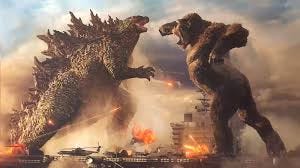
When King Kong vs. Godzilla (1965) came out, I could think of nothing else until I got to see it. Dad took me, which was fine, but I could not understand his reaction. When Kong uprooted a huge oak and thrust it down Godzilla’s throat, sending Godzilla’s eyes rolling, Dad erupted in laughter. I could only figure that, though he was a great dad, he just could not appreciate the fine points of high drama. When in 1964 Aurora Plastics Corporation produced its Godzilla plastic model kit, I immediately purchased it, painted it a lurid green, and assembled it, and, sixty-one years later, it still sits in pride of place on prominent display in my man cave.
Of course, at the time I did not know the history of the original Japanese film Gojira (1954). I did not see the original until I was an adult. It was not kitsch, but a serious and important film, mutilated by the American version. Gojira was filmed in the immediate aftermath of the Castle Bravo incident. On March 1, 1954, the United States detonated a thermonuclear device on Bikini Atoll in the Marshall Islands. The estimated yield of the device was predicted to be six megatons, but it “ran away” to fifteen megatons, the largest blast ever detonated by the United States. So powerful was the blast that the firing crew, sheltering in a steel-reinforced concrete bunker twenty miles away, felt their bunker rolling like a ship in a storm. The concrete walls shivered and groaned but held. The fireball was four miles in diameter, and the flash was so brilliant that it was seen in Okinawa, thousands of miles across the Pacific. It could have been seen from Mars had anyone been looking. Later in the day, extremely radioactive ash, falling precisely where it had been predicted not to fall, dusted the populated island of Rongelap, causing the local Marshallese people severe radiation sickness. Of course, the islanders had been given no warnings or notice whatsoever.
However, the most notorious effect of the Castle Bravo test was on the crew of the Japanese tuna boat The Lucky Dragon, #5 which was fishing in what was supposed to be the exclusion zone about seventy-five miles from ground zero. Early in the morning they were startled by a brilliant flash and the sight of what appeared to be the sun rising in the west. Minutes later, roaring like thunder resounded across the ocean. A couple of hours later, a strange precipitation began to fall. It could not be snow in the tropics. It was something much stranger—highly radioactive pulverized coral. The crew just swept it off. Some tasted it and found that it had no flavor. Some hours later, the crew began to exhibit all the excruciating symptoms of extreme radiation poisoning. They were able to return to Japan, but before news of what had happened to them was known, their catch of tuna was sold. When word of the radioactive crew and its tainted tuna came out, the seafood-loving Japanese swore off tuna for weeks.
Needless to say, the Japanese, who had suffered the atomic attacks on Hiroshima and Nagasaki, were furious that an American bomb had caused more suffering among its citizens. One member of the crew died, and the rest suffered serious illness. The American response was predictable. Lewis Strauss, the head of the Atomic Energy Commission, offered copious denial and spin and downplayed the harm done to both the Marshallese and the Japanese victims of Castle Bravo.
The opening scene of Gojira is an obvious reference to Castle Bravo. The crew of a merchant ship is sailing peacefully, when suddenly the waters begin to boil. They rush to the railing and are blinded by an explosive flash. American nuclear testing has awakened Godzilla and sent him on a murderous rampage. He heads straight for Tokyo.
In the fifties, the state of the art for monster movies was stop-motion animation as perfected by the great Ray Harryhausen. Harryhausen handled the special effects for many memorable films, such as The Seventh Voyage of Sinbad, Beast from 20,000 Fathoms, It Came from Beneath the Sea, and The Mighty Joe Young. I remember especially Jason and the Argonauts (1963) which I saw at the drive-in when I was 11. In one riveting sequence an enormous bronze giant comes alive and wrecks the Argo and its crew. Gojira had a very tight filming schedule, and stop motion was a very slow process, so there was no choice but to make Godzilla with a man in a monster suit. However, the result was most effective.
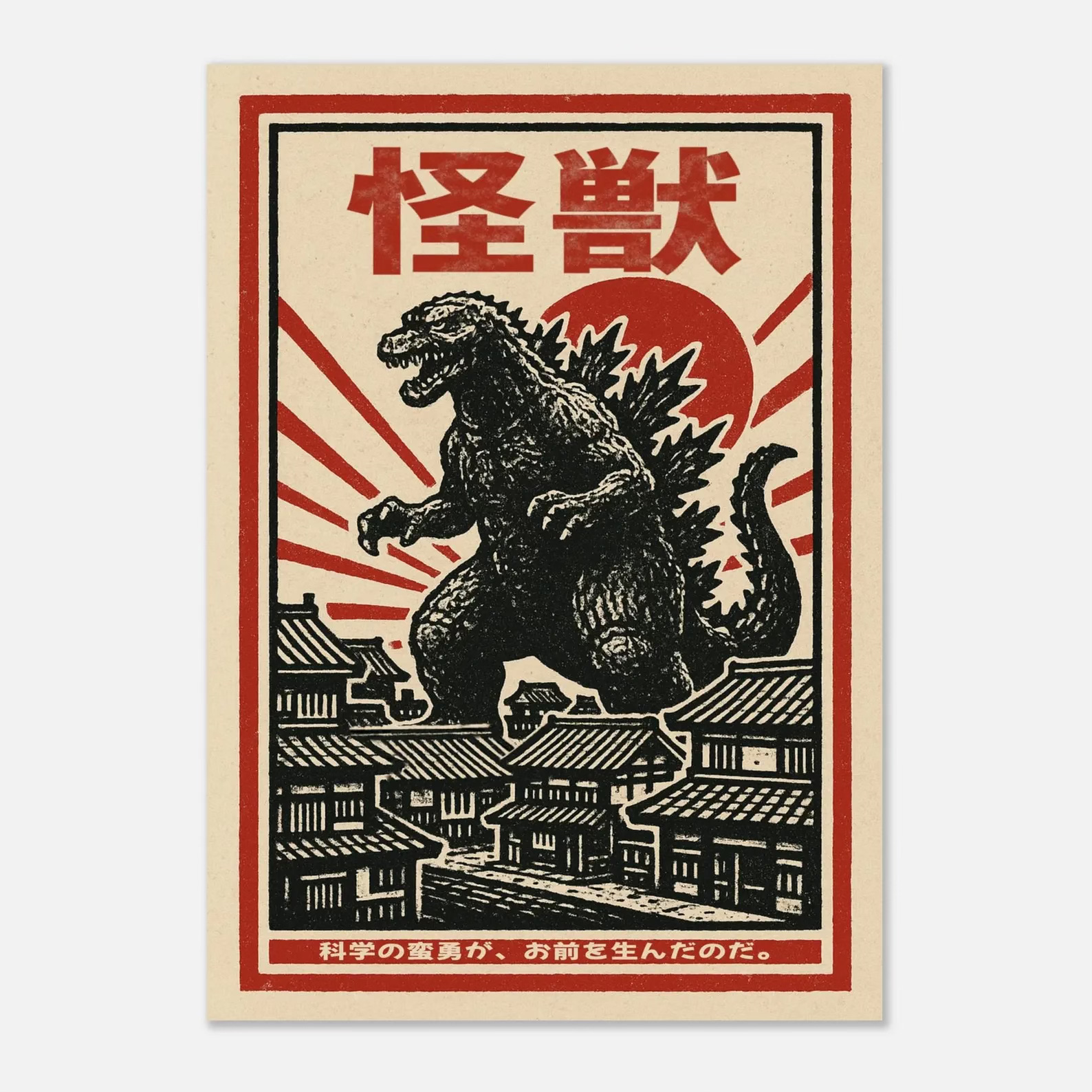
Today, of course, Godzilla is an awesome computer generated creation. It was not clear at first what kind of monster Godzilla would be. The Japanese “Gojira” means “gorilla whale.” Fortunately, they decided on the dinosaur-like monster with giant pillar-like legs, huge grasping arms, a toothy mouth, a long tail and, best of all, jagged thorns up and down the spine that burn fiercely when Godzilla projects his fiery breath. Godzilla has evolved in appearance over the years, becoming less sumo-like and more monstrous. The latest iteration in Toho Production’s magnificent Godzilla Minus One (2023) is a truly terrifying beast. A sequel, Godzilla Minus Zero is coming out in 2026.
One thing that always mystified me about Godzilla is why he was impervious to all weapons. Ordnance that would sink a battleship has no effect. We have to remember, though, that Godzilla is not really supposed to be a biological organism. He is a nuclear weapon made flesh. I guess you would have to think like the Japanese to really get the concept. Like a nuclear weapon, Godzilla is unstoppable. Like a nuclear weapon, he destroys by overwhelming strength that nothing can resist and burns everything with nuclear fire.
Godzilla did not long remain the only kaiju. Other great beasts had to be invented to give him something to fight. Mothra is a monstrous lepidopteran with the superpower of spitting sticky silk that can gum up and immobilize anything, including Godzilla. Rodan is a gigantic flying beast who takes out an entire squadron of F-16s in Godzilla, King of the Monsters (2019). Kong is the big gorilla of Skull Island supersized. Godzilla’s most dangerous foe is King Ghidorah, a three-headed dragon-like alien larger and stronger than Godzilla. When he first appeared, in Ghidorah, the Three-Headed Monster (1964), it took an alliance of Godzilla, Mothra, and Rodan to beat him. Badass.
Larger issues have also been a part of the Godzilla films from the beginning. In the original Gojira, a prominent scientist says that Godzilla should be studied rather than destroyed. In the later film Godzilla vs. Mothra (1964), a greedy corporation tries to exploit Mothra for profit, with predictably bad results. Later films play up the ecological perspective, presenting Godzilla and the other “titans”--the other kaiju such as Rodan, Kong, and Mothra—not as forces of sheer destruction but as restorers of a lost environmental balance (King Ghidorah is sheer evil.). I think the message of the original Gojira is still the best:
We are the monsters.
Like a great beast, the nuclear monster was unleashed and when and where it will come to rest no one knows.
Note: Anyone may copy and publish what I or my guests write, provided proper credit is given, that it’s not done for commercial purposes, that I am notified of the copying (you can just leave a comment saying where the copy is being published), and provided that what we write is not quoted out of context or distorted.
Thanks again for reading Letters … . Subscribe for free (always) to receive new posts and support my work.
Thank you for elaborating on Godzilla- my “spirit animal”, and other fabulous pre-CGI creatures. 🤣 // When working on Zika in the Marshall Islands years ago I visited their small, but quite interesting, history museum. It provided remarkable images and history of the atomic testing. There was also a very small Veterans Administration facility for monitoring Marshallese on their main island for radiation effects/illness. There were a number of remarkable films shown on Marshallese TV from the atomic testing time. Doubt the clinic had significant treating capabilities. // The prior N Korean leader was quite the Godzilla fan. He even had the actor who wore the Godzilla costume as a guest, with costume, to N Korea! Was reportedly also quite the film buff.
Never into monster films, but I still deeply appreciate this essay.
My tendency today would be to read it as an allegory of private equity, but that's a different story.